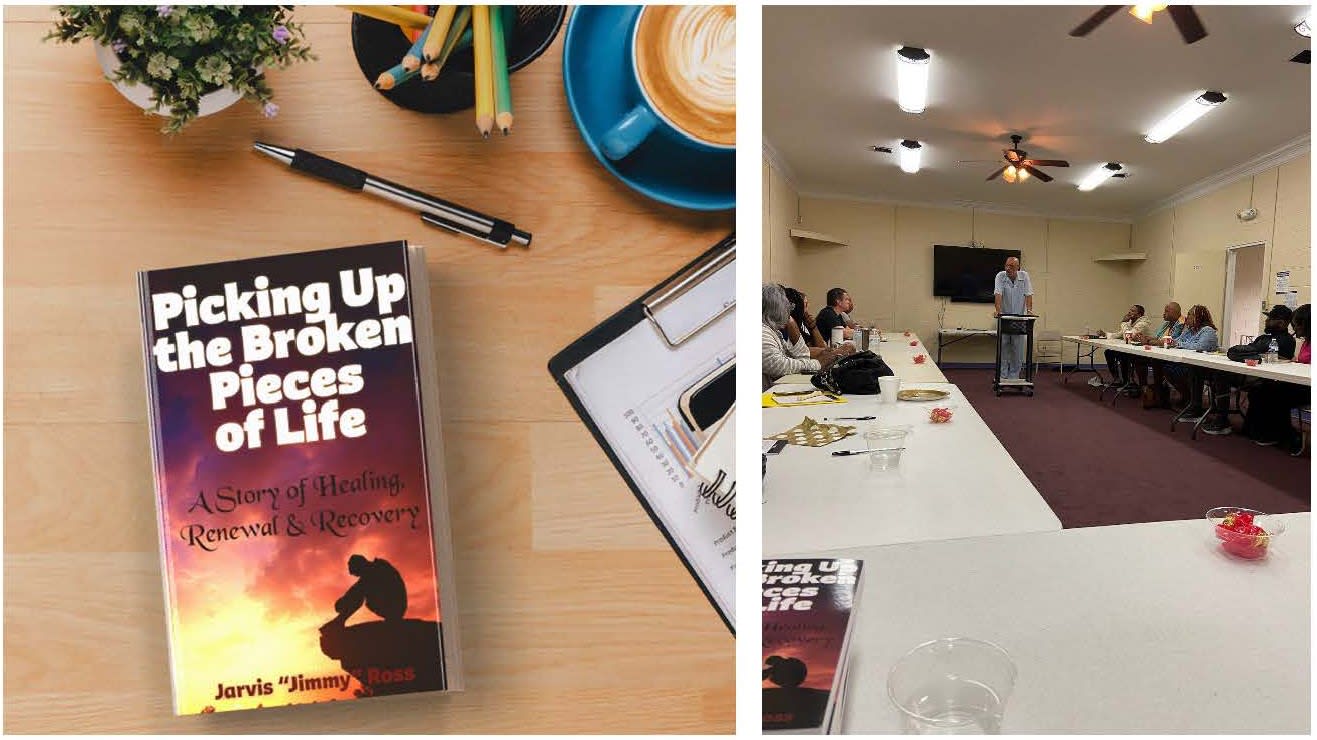
Picking Up The Broken Pieces Of Life

A Novel Narrative—By Jarvis “Jimmy” Ross PREFACE—Human Fate Ends Where Divine Destiny Begins—
PICKING UP THE BROKEN PIECES OF LIFE BEGINS WITH FAITH
Does trouble have a purpose and if it does, what is it? Or, is it a dilemma wrapped up in an enigma? That’s the reality of life in the Book of Job which tells a story—that I deem true—of the source and path of trouble. Let’s call it the purpose of trouble which is usually a taboo subject because human nature seeks to avoid pain and seek pleasure. But we can’t have sunshine without some rain. So let’s look at trouble and the idea that it could have a purpose that overrides pain and suffering.
The Book of Job unveils many of the problems that we encounter and fall prey to at one point or another. But, did you know that Job’s troubles are all-inclusive and there is no doubt that we will all face similar problems because of the commonality of human nature? Yes, we all can go through grieving the pain and death of loved ones; rejection; mental-emotional abuse, physical abuse; bankruptcy and financial setbacks; sickness and disease; failed marriages; abandonment by friends and family; betrayal; toxic relationships, judgmental criticism; loneliness and isolation; depression; suicidal thoughts . . . “and the band played on.” The latter is taken from the blockbuster big-screen hit, The Sinking of the Titanic, referencing the band playing while the ship sank. In similar ways, we can deliberately mask and downplay impending calamity that can be associated with anosognosia or the condition of denial. Are we taking our troubles for granted or do we see the signs?
Human fate follows the course of the demise of the world due to the downward spiral of human dignity and self-respect. The decline in our humanity causes ambiguity about God’s imminence in the circumstances of life, thus affecting the faith perspective. Is God in or out in this situation? Nevertheless, every human being will be allowed the opportunity to encounter a divine purpose at some point that must be identified. When that happens, a problem arises that poses two choices concerning which way to go. We call it “fight or flight.” But there are more than two choices when we are faced with trouble. The other choice is to wait and weigh your direction.
THE FAITH DILEMMA
Because of the nature of a complicated faith perspective in any form of religion, we barely understand the spiritual angle or the source behind our faith, let alone human existence (existentialism), and the purpose of the power of choice. Where does our power of choice (free-will) lead us through faith? Unfortunately, bad traumatic experiences in natural life can impede, disrupt, and alter our faith and cause us to doubt the existence of God. And, without God, where are we?
In this modern age of the spread of the New Age, the faith perspective of people has become very murky, even among Christians. It means that there are a plethora of categories of faith along a pantheon of gods. It has become as complicated as it sounds. Faith in . . . has become like a multiple-choice question. We either put our faith in the God of the sacred text of Scripture (known as the Bible) or some other source. Because of the controversies in Christianity, there is even a steady stream of seekers questioning the faith perspective presented to them, and leaving the Church for some of the following reasons:
There seem to be conflicts and contradictions between what is portrayed about Christians in the Bible compared to what we see and hear today from historical, traditional, institutionalized Christianity because of translation hermeneutics, meaning translators have put their spin (interpretation) on the meaning of the copied text. (The original parchments and scrolls are purported lost or hidden in the Vatican called the Codex Vaticanus.) Those changes in translations have justified the atrocities of war-mongering, advocating a violent God; dominating and oppressing indigenous people and rival nations through massacres for wealth, power, and control; even slaughter and rape; imperialism and colonization that seizes land and people, making them bond-servants or slaves; genocide; biased politics, and government mandates that oppress minorities. It has “actually” become a dilemma in politics as well as religion that affects the outcome of who leads the country.
Those historical atrocities seem to be highlighted in some Christian circles today and are being vilified through politics as the way of God that uses force and aggression. This is causing an exodus because those justified characteristics do not reflect the character of Christ or His followers. That is the cry of those leaving the Church seeking other means of their faith that suit their fancy, which can be a journey of futility.
God is not a hostile, violent God, angry with “so-called” heathens, infidels, and heretics. Then excusing it as the wrath of God to purify the land. I thought God reached people through love and compassion, and is the Author of Peace, not war or destruction.
So, settling on faith in God is like navigating your way through a maze. It’s either faith in an object like a vision board; faith in the elements of the universe and nature, faith in some charismatic leader, faith in what we imagine in our mind and the words we bellow out of our mouths; or faith in ourselves as a little god; or evolution from an impersonal first cause. Other religions have different perspectives, so you see it’s a multiple-choice question. The deciding factor for me is that do they offer a redeeming Messiah who atones for our human frailties, shortcomings, errors, faults, and imperfections, translated as “sin” in the British language; cleanses the conscience, and transforms their lives from living the wrong way to the right way? You might ask, “What’s the wrong way?” And my answer is, “Anything that is destructive and disrupts progress toward a better life.”
So, let me talk directly to you for a moment about faith perspectives, and remember faith perspectives are like personal viewpoints or even opinions defined as “man’s concept of God.” That’s the theological edge. I draw my conclusions from the pragmatic viewpoint which outlines the sacred text of Scripture in practical, understandable, relevant terms as I point out a “down to earth” God of the sacred text.
Now if indeed there is one God of the Universe and not a plethora of gods, someone is wrong and someone may be right. That will be decided on the “Day of Reckoning” by the Eternal God and Creator after death, and death is a mystery. Before death, the question for many is, “Who is the One True Living God?” Again that’s your choice but please pray for the right choice because that decision is eternal. Atheism and Agnosticism will finally have an answer on that Day.
Most religions (as far as I know) believe in a “Day of Reckoning” and if that’s true, we will all find out the truth on that Day. In the interim of eternity, it is our choice, but make sure you also consider the consequences of religious judgment versus salvation and the restoration of life eternal. Although life after death seems far-fetched in our finite minds, just as we are moved to purchase health and life insurance, we should be just as concerned, even more, concerned about our eternal security.
*******
I’ve chosen a passage from the Book of Job to develop the parallel of his troubled life with our troubles. It intrigued me. It emphatically points out that although his life was riddled with calamity, distress, and disaster, there was a positive outcome to it all.
So the Lord restored what Job had lost after he prayed for his friends, and the Lord doubled all that had belonged to Job. So they came to him, all his brothers and sisters and all who had known him before, and they dined with him in his house. They comforted him and consoled him for all the trouble the Lord had brought on him, and each one gave him a piece of silver and a gold ring. “So the Lord blessed the second part (latter end) of Job’s life more than the first. He had 14,000 sheep, 6,000 camels, 1,000 yoke of oxen, and 1,000 female donkeys (Job 42:10-12).
But a loss is a loss and how do we recover from losses when it seems as though it depletes us? Ironically, Job’s life was even better than it was before his catastrophic episodes. But how can we pull anything positive out of a negative?
TROUBLE?!
He didn’t think he did anything wrong because he lived in the lap of luxury. That is the man Job. The thinking of three close friends and the populous around Job was that his loss of wealth was a sign that he was out of favor with God. God no longer approved of his life. But that’s carnal superficial thinking that lacks insight into the perplexities of life. It’s like standing on the outside of a house looking through the window; hearing jabber and vaguely seeing people in the house, but not knowing what’s really going on. Then we assume the worst. Unfortunately, laws don’t consider circumstantial evidence. It only considers concrete facts. So, even if you didn’t do everything they said, you are guilty until proven innocent. So follow your gut and stay as far away from trouble as you can. But know this, trouble will find a way to you, so be ready.
Job’s plunge into abject poverty and the absence of family and friends was seen as the end of his life. Well, why not, from the human logic perspective? What use is it to live without someone who loves you, someone you can love, and things that bring comfort? He was alone, yet he wasn’t lonely because God was with him. But God can be very mysterious and seemingly absent when we are faced with a problem because God is growing our faith without seeing or feeling anything. How will we proceed without seeing or feeling anything that indicates we will make it?
He thought that God was on his side, so when things went south, God was blamed for his impending calamity and he accepted his fate as judgment for something he had no clue about. But God doesn’t take sides. God is on God’s side and radiates love for humanity created to represent the attributes of God’s goodness, not evil. It’s really easy to discern: Good improves life. Evil diminishes life. Good improves the quality of character. Evil corrupts character. Good elevates people seeking good. Evil downgrades and degrades good people. According to the scrolls of Scripture and various religious texts; God is good and the devil is evil. But the question persists among those who fear the unknown. What side is God on?
Trouble is an uninvited foe that terrorizes the life out of its innocent victims. “Man, born of woman, lives but a few days, and they are full of trouble” (Job 14:1). “For evil does not come up from the dust, nor does trouble spring up from the ground, but people are born to trouble, as surely as the sparks fly upward” (Job 5:6-7). Like a wild beast, trouble ravishes its prey and feasts sumptuously on the remains of a torn-asunder life. It divides the carcass and devours it until, alas nothing remains. But faint not, for there is meaning in life, even in the midst of trouble. When fate clashes with divine purpose, it produces a way out of trouble.
“Not only this, but we also rejoice in sufferings, knowing that suffering produces endurance, and endurance, character, and character, hope. And hope does not disappoint, because the love of God has been poured out in our hearts . . .” (Romans 5:3-5a). “No trial has overtaken you that is not faced by others. And God is faithful: He will not let you be tried beyond what you are able to bear, but with the trial will also provide a way out so that you may be able to endure it” (1 Corinthians 10:13).
In the scenario of heaven, trouble has an assignment and job to do like a sculptor. The idea is to take a lump of shapeless hardened clay out of the ground and place it on the potter’s spinning wheel to shape it (known as throwing) into something beautiful to behold. Trouble Shapes Us In The Hands Of God.
“Shoot for the Moon. Even if you miss, you’ll land among the stars” (Norman Vincent Peale). That quote should be the aim of life to its fullest. Nevertheless, before we can say that in good conscience, we must address the roadblocks and the biggest roadblock is answering the elusive pervading question, “Why do bad things happen to good people?” For that matter, “Why do good things happen to bad people.” Life, at times, seems to be so unfair to us. When we are doing our best, why do things turn out not-so-good? Well, recovery is a process of restoring losses and takes time. I know many of you reading this have been there. It is “actually” a journey towards a better life. But, to get there is a refining process through good and bad that shapes a well-rounded fulfilled life. That’s the aim of those seeking “to live their best life now.” Here’s a formula: CPR.
Normally, we refer to CPR as the acronym for the medical terminology of Cardiac Pulmonary Resuscitation: A method of reviving arrested heart conditions. Just as a shortage of blood flow to our hearts due to hardened arteries can result in heart attacks, thus requiring CPR, there are times when our faith and spiritual arteries are hardened because of difficulties, frustration, and disappointment and we lose sight of our direction. That too lessens the life-giving flow of faith that can restore the lack of vision in our spiritual hearts and requires a form of resuscitation. The difference is CPR here stands for understanding the Crisis; Pace; and Restoration.
THE CRISIS
A crisis is a turning point that is usually imposed on one’s life at unsuspecting times, leaving us bewildered. We all have crises that we knowingly or unknowingly will encounter. That’s life! A crisis comes with some form of trouble that becomes a problem that we must figure out like a puzzle. The dilemma for many is finding the answer and solution. Many of the problems and troubles we face are out of our control, but the solution is within reach. As a turning point, a crisis requires a decision regarding the direction to take. It’s like coming to a fork in the road. Do we go right or left? Or, can we just pave our own way and go straight ahead? In the simplicity of a spiritually guided life, our faith perspective should provide an answer.
God, in omniscient wisdom (all-knowing), has an answer but are we willing to choose God’s way when we are not sure because, humanly speaking, it doesn’t seem like the best way? That’s where faith comes in and we shouldn’t become pessimistic about faith because all of life requires some level of faith. Faith encompasses all of our decisions in life whether we can see the results or are oblivious to the results. Every day when we wake up, we must make a faith decision to get up and go about our routines. Then it starts all over the next day. Sometimes it may feel like we are in a “time loop,” experiencing “Groundhog Day” or some sort of Deja Vu. We’ve all felt it from time to time.
Faith is believing against all odds and never giving up on one’s dreams for a better life. “Hoping against Hope” means that we have doubts but we still hope. Strong believers still hope when it seems hopeless, like Abraham, the Father of the Faithful. Faith and hope never come without doubt, but faith presses against doubt. In pragmatic terms, it means that we will have mixed emotions about our direction that we must cast aside. But harken, given the complexities of life, there will be challenges that stand in the way of reaching that better life. Faith, like financial investment, requires taking a chance with the possibilities. We don’t think at the moment this way, but when we do think about it, many of life’s decisions are a gamble. That’s risky and most people aren’t willing to take a risk, especially with their money. That brings us to a pertinent point about faith and money. Let’s do some situational analysis of Job’s predicament that will flesh out in the pages to come. His wealth seems to be at the core of his crisis!
It matters not whether we do not believe in God or the devil because it doesn’t change the reality of the verifiable existence of good and evil in the world. Evil is described as destructive and good is constructive. When good things happen, people improve and rejoice. When bad things happen, people cower in the corner of life in fear and become depressed. The question of faith is, is there an entity behind good and evil, and if so, can they be identified? That is, can the influences of people be identified as good or evil, and the answer is an emphatic yes because there are human demagogues.
*******
In the story of Job, Satan, the enemy of God and humanity appears at the threshold of heaven before God to challenge God’s rule. Can you imagine that in the stellar heavens? Satan’s challenge was twofold: First, Job saw his wealth as approval from God; Second, God protected him with wealth. That was Satan’s argument and it appeared that way from the human perspective, but it wasn’t God’s way. That’s always the backdrop behind our trials and temptations; the confusion of where is this trouble coming from and why. Is God behind our trials or is it the devil? The source will determine your action but it begins with discernment.
Where does our faith lie
JJ Planter & Middle Mission Writing & Consulting
Our Location
I’d love to hear from you!